You've Made $100K in Sales. Here's Why You're Not Keeping Any of It.
Most founders track revenue, not margin. Here's the math behind why $100K in sales can still mean an empty bank account, and what actually fixes it.
$100K in sales feels like proof. The orders are coming in, people want what you're making, and by every outside measure things are working.
So why does your bank account still look like it did at $50K?
I've asked founders this question a hundred times and almost none of them can answer it right away. Not because they're bad at business. Because nobody ever told them there's a second number to watch, and revenue was never it.
The number that's actually hiding your problem
Every founder watches revenue. It's the one that shows up in Shopify, the one you screenshot, the one that feels like proof you're doing something right. Almost nobody watches margin by SKU, and that's exactly where the money disappears.
Take two products that both sell for $30. One costs you $12 to make and ship. The other costs $22. On your dashboard they're identical, two more sales, same green checkmark. In your bank account they're not even close.
Now run that gap across a real catalog, twenty or forty SKUs, some winning quietly and some bleeding you dry every time someone hits "buy." At a blended margin around 30%, $100K in sales leaves you with $30K before payroll, ad spend, and returns take their cut. Get that same $100K to a 60% margin and you're sitting on $60K instead. Same sales number. Twice the cash in the account.
Curious where yours lands? The Margin Leak Calculator will show you, product by product, in about five minutes.
Why revenue keeps lying to you
Revenue is a comforting number because it only moves in one direction that feels good. More sales, bigger number, screenshot it. Margin is uncomfortable because it forces you to look at cost, and cost is where most founders stop paying attention the moment a product goes live.
Here's what that looks like in practice. You launch a product. You price it based on a rough sense of what feels fair, maybe what a competitor charges, maybe just a number that felt right at 11pm. Costs creep from there: a supplier raises prices and you don't notice for two quarters, a shipping carrier changes rates, a return policy gets a little more generous than it should be. None of these show up as a single dramatic event. They show up as a slow erosion that revenue never reflects, because revenue is just units times price. It doesn't know or care what any of it cost you.
By the time you're at $100K in sales, that erosion has usually been compounding for a year or more, quietly, across every SKU, without a single alarm going off. You don't feel it until you look at your bank balance and it doesn't match the story your revenue chart is telling you.
What actually changed for the founders who fixed it
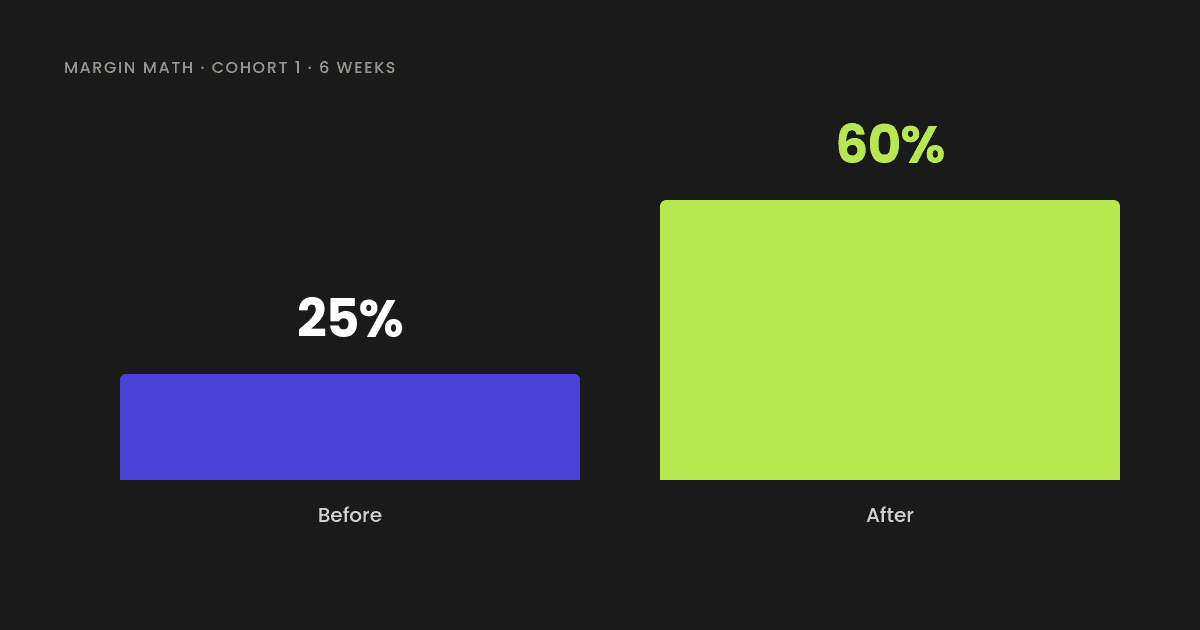
Brands that have run through Foundations First have moved their average margin from 25% to 60%.
Reporting on this shift: She & Success, "Why Profitability, Not Revenue, Is the Growth Strategy for Canadian Women Entrepreneurs"
None of them sold twice as much. A few barely grew revenue at all. What they did was smaller and much more specific, and it broke down into three habits that showed up across almost every founder in the room.
They stopped setting prices by glancing at what competitors charged and started with what a product actually cost them to make, ship, and support, then added enough room to reinvest. Competitor pricing tells you what the market will tolerate. It tells you nothing about whether you can survive charging it.
They started checking margin SKU by SKU instead of judging the whole business off one number at the top. A blended margin can hide a lot. You might have three products quietly funding one that's been losing you money since the day it launched, and a single top-line number will never show you which is which.
And when they found a leak, they went after the leak, not the product. Usually it was packaging that cost more than it needed to, or a shipping method nobody had questioned in two years, or a supplier deal that was never renegotiated after volume went up. Founders default to thinking a margin problem means the product is wrong. Almost every time, it's something upstream of the product entirely.
It usually looks like this. Picture a founder whose best-selling product turns out to be the one losing her the most money. She'd been so focused on unit volume that margin never made it onto her radar, and the product with the highest sales count was also carrying the thinnest margin in her whole catalog, low enough that every sale was barely breaking even once shipping and returns were factored in. Six weeks later that same product was her most profitable line. Nothing about the product itself had changed. She'd renegotiated a supplier contract that hadn't been touched since her first year in business, and switched a shipping method that was costing her almost double what a comparable option would have.
What a real margin audit actually looks like
If you want to do this yourself before touching a single tool, here's the version you can start on paper today.
Pull your full product list and, next to each one, write down exactly what it costs you, all in. That means the unit cost, the packaging, the average shipping cost per order, and a rough estimate for returns based on your actual return rate, not what you hope it is. Subtract that total from your selling price. What's left is your real margin on that product, not the number you assumed.
Sort the list by margin, lowest to highest. The bottom of that list is where your leak lives. Sometimes it's obvious once you see it laid out, a product you've been pushing hard in ads that's barely profitable once real costs are accounted for. Sometimes it's quieter, a slow bleed across several products that never shows up as one dramatic problem.
From there the fix is almost always one of three things: raise the price to reflect true cost, cut a specific cost that's inflated for no good reason, or stop actively promoting a product that's structurally unprofitable no matter what you do to it. Most founders default to guessing at the first option and skip the second and third entirely, which is exactly why the leak keeps draining month after month.
If you're standing where most founders are right now
If you've crossed $100K and still don't actually know your margin by SKU, that's not a red flag on you. That's just where most founders are at this stage, because nobody ever handed them the second number.
It's not complicated once you can see it. It just hasn't been visible until now.
Start with the Margin Leak Calculator to find out exactly where your money is going. From there, the 2-Year Cashflow Tool shows what a real margin shift does to your runway over time, not just this month. If you want a broader read on how you operate as a founder, the Founder Type quiz takes about two minutes and might explain a few habits you already knew were there.
And if the plan after $100K was to hire a marketing agency, read agency or fix your margins first before you sign anything. The unit math on which one goes first is not close.
Foundations First is a six-week paid program for founders past $100K in sales who are ready to keep more of what they make. Learn more about Foundations First.