The Founder Who Grew 40% and Almost Ran Out of Cash
Revenue growth doesn't always mean more cash in the bank. Here's why fast growth can drain a business, and how to see it coming before it happens.
Picture a founder mid-panic. Sales are up 40% year over year. Every metric on her dashboard is green. And she's got six weeks of cash left before payroll becomes a problem.
This is one of the most common things we see, and almost nobody expects it. Growth is supposed to be the good outcome. Nobody warns you it can be the thing that breaks you.
Why growth eats cash instead of making it
Here's the part that doesn't make intuitive sense until you've lived it: more sales usually means more cash going out before more cash comes in.
You have to buy inventory before you sell it. You have to pay for ads before the resulting sales land. If you offer any kind of payment terms or run a wholesale channel, you might be waiting 30, 60, even 90 days to actually collect what you're owed. Every one of those gaps has to be funded by cash you already have, and the faster you grow, the bigger those gaps get, because you're buying more inventory and running more ads to fuel the growth in the first place.
A business growing at 10% a year can usually fund that gap out of existing cashflow without much strain. A business growing at 40% often can't, not because the business is unhealthy, but because the math of the gap scales faster than most founders account for.
This is why a business can look incredible on a P&L and still come within weeks of missing payroll. Profit and cash are not the same thing, and revenue growth makes that gap wider, not smaller.
What that actually looks like
Her business was profitable on paper. Every unit she sold made money. But she'd scaled ad spend and inventory orders together, assuming the cash from this month's sales would cover next month's costs the way it always had.
It didn't, because next month's costs had grown 40% too, and the cash from this month's sales hadn't caught up yet. She was profitable and nearly out of runway at the same time, which is a disorienting place to be as a founder. Every number said the business was working. Her bank balance said something different.
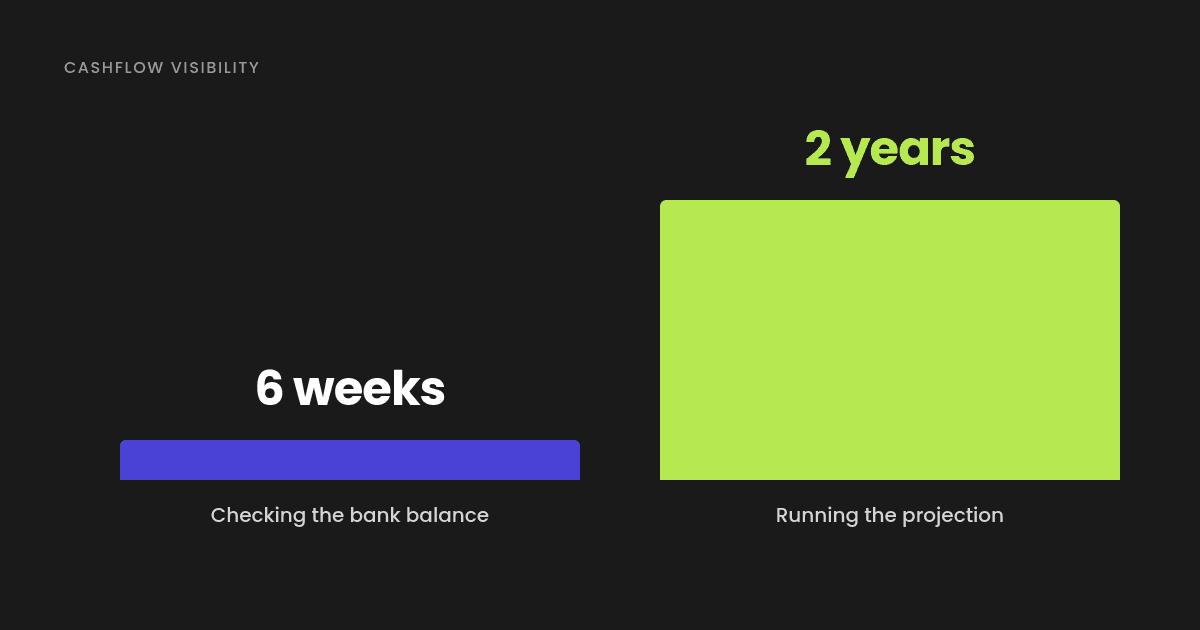
Run those numbers through a two-year cashflow model instead of looking at this month in isolation, and the problem becomes visible. Month to month, the gap looks manageable. Projected forward, it shows a business that runs out of cash in six weeks if nothing changes, and one that's fine if inventory orders slow by even two weeks and payment terms get renegotiated with one supplier.
That's the whole fix, in most cases. The crisis doesn't come from the business being broken. It comes from never having looked more than 30 days ahead.
Why most founders don't see this coming
Most founders track cash the way they track weather, reactively, by checking the bank balance and reacting to what's already happened. That works fine when growth is slow and predictable. It stops working the moment growth accelerates, because by the time a cash problem shows up in your bank balance, the decisions that caused it were made weeks or months earlier.
The fix isn't complicated, but it does require looking further out than most founders are used to. A two-year cashflow projection isn't about predicting the future with precision. It's about seeing the shape of what's coming, inventory timing, ad spend scaling, payment term gaps, before it becomes an emergency instead of a decision.
Run your own numbers through the 2-Year Cashflow Tool to see what your growth curve actually does to your runway, not just this month, but the months your current trajectory is quietly setting up.
What to actually watch instead of your bank balance
Three things matter more than the number sitting in your account right now.
Your inventory-to-cash cycle: how long between paying a supplier and collecting cash from the resulting sale. The longer that cycle, the more cash growth demands upfront.
Your payment terms, both what you extend to customers and what you're given by suppliers. Every day of terms you extend is cash you're funding on someone else's behalf. Every day of terms you can negotiate from a supplier is cash you get to keep longer.
And your growth rate against your margin. High growth with thin margin is the combination that drains cash fastest, because you're funding more volume without enough profit per unit to refill the gap. This is also why the founders who've fixed their margin first tend to handle growth spikes with far less cash strain than founders scaling on thin margins. If you haven't run that audit yet, the margin math behind it is worth doing before your next growth push, not after.
Foundations First is a six-week paid program for founders past $100K in sales who are ready to keep more of what they make. Learn more about Foundations First.