Why Staying Boring on Purpose Beats a Rebrand Every Time
Founders think their branding problem is that it's stale. Usually it never had a chance to compound. The case for staying consistent instead of rebranding.
Heinz has run "57 Varieties" since 1896. Same claim, same message, for well over a century. Nobody at Heinz is losing sleep wondering if it's time for a refresh.
Most founders past $100K in sales are on their third logo by now, and quietly wondering if it's time for a fourth.
The instinct to rebrand is usually a signal about something else
When sales slow down or a launch underperforms, branding is one of the first things founders question. It feels productive. New logo, new palette, new voice, something visible to point to as progress.
But branding is rarely the actual problem. More often, the business changed something real, pricing, positioning, the offer itself, and the brand just happens to be the most visible symptom sitting on top of it. A rebrand fixes the symptom and leaves the real issue exactly where it was, just wearing new colors.
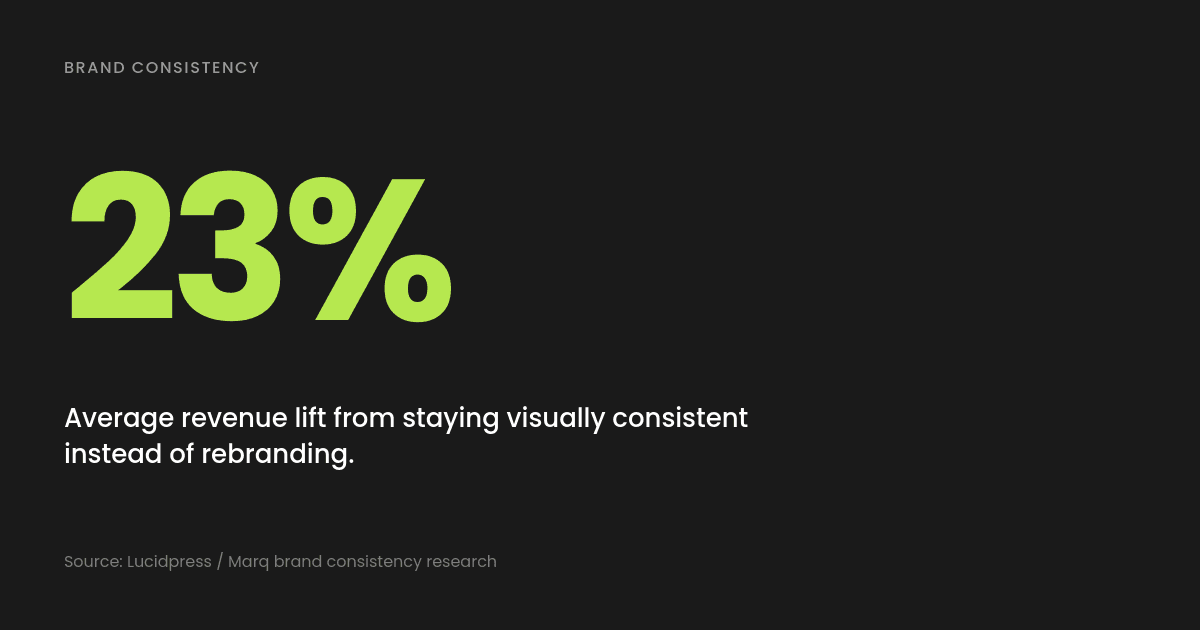
Consistency, brand researchers at Lucidpress and Marq found, is worth a 23% average lift in revenue for brands that stay recognizably consistent versus those that don't. That number isn't about having a good logo. It's about a customer seeing your product in five different places, an ad, a package, a website, a friend's story, and instantly knowing it's you, every time, without having to think about it.
Every rebrand resets that recognition to zero.
What consistency actually buys you
Recognition compounds. It's not something you get from a good design pass, it's something you earn from years of a customer seeing the same thing enough times that it becomes automatic. The 23rd time someone sees your packaging, they don't process it consciously anymore. They just know it's you. That's the actual asset. Not the logo itself, the automatic recognition sitting behind it.
That asset resets every single time you rebrand. All those years of quiet recognition, gone, and you start the clock over at zero with a customer base that now has to relearn what your business looks like.
This is why brands that seem almost stubbornly boring about their visual identity tend to outperform ones that refresh constantly trying to stay current. Heinz didn't stay relevant for over a century by chasing trends. It stayed relevant by being unmistakably, consistently itself, long enough that "57 Varieties" stopped being a slogan and became a fact people just knew.
When a rebrand is actually the right call
None of this means never touch your branding. Sometimes the brand really is the problem, not a symptom of something else.
If your visual identity was built fast and cheap in year one and doesn't reflect the quality of what you're selling now, that's a real gap worth closing. If your positioning has fundamentally changed, you started as a budget option and now compete on premium, or vice versa, your old branding may be actively working against the business you've become. And if you've never actually defined your brand rules in the first place, colors, fonts, tone, layout logic, so every asset gets designed from scratch with no consistency between them, that's not a rebrand you need. That's a foundation you never built.
That last one is the one we see most, by far. Founders assume they need a whole new look, when what they're actually missing is a locked set of rules that make everything they already have look like it belongs together.
How to know which one you actually need
Pull up your last five pieces of marketing, an ad, a product page, a package, a social post, an email. Look at them side by side. If they look like they came from five different businesses, you don't need a rebrand. You need brand rules that don't currently exist.
If they already look consistent and the problem is something else entirely, sales, positioning, offer, no rebrand will fix that. It'll just cost you the recognition you'd already built while the real problem sits there untouched.
The Brand Guide Tool walks you through locking your own version of what Heinz has had since 1896, a consistent set of rules simple enough that every future asset automatically looks like it belongs to the same business, without a redesign every time something feels stale.
Foundations First is a six-week paid program for founders past $100K in sales who are ready to keep more of what they make. Learn more about Foundations First.